miércoles, 6 de junio de 2012

de GRISOGONO Power Breaker Chronograph N08 Watch Available On James List


In my opinion de GRISOGONO is a pretty interesting and yet under represented brand (at least in the US). I am not familiar with their entire collection, but some of the stuff is interesting. A watch that epitomizes their sport piece collection is the oddly named "Power Breaker." In gold, it has a name that sounds like a piece of construction equipment. That or a WWE wrestler.

A lot of this stuff just slips through the cracks. This "N08" Power Breaker Chronograph watch actually came out last year. In 18k rose gold, the case is... squarish and so GRISOGONO. What does de GRISOGONO even mean? I love the watch strap. Looks like part of a Stillsuit the "Fremen" wore on Arrakis in Dune. You fellow nerds know exactly what I am talking about. Though I could easily like without the "Power Breaker" logo on the side of the rubber strap. Sounds like something that would be applied in purple lightning graphics on the side of a souped-up Dodge Ram pickup truck.

Wait a minute, de GRISOGONO is thinking along those lines already! Look at that oddly placed gold plate on the dial at 7 o'clock. Engraved right on there in power cursive is "Power Breaker." Screw the lighting letters, they already have the text done for you! de GRISOGONO really does think of everything.


The green elements on the dial match the "snakey" theme of the strap quick well. And how often do you get a watch with gold and green together? Not often I would guess. While unconventional, the dial is legible, and it displays the time and the chronograph counters - no sub seconds dial. The case itself is 42.5mm wide with a sapphire crystal. Inside the watch is a Swiss automatic movement, but I am not sure by who. It has further been modified specially for de GRISOGONO according to them.

According to the brand the watch dial is supposed to remind you of a racing car's gauges. Either I haven't been in enough race cars or that makes no sense. Monster truck ? Maybe. "Folks get ready! All cars stall in fear... of the POWER BREAKER. The demolition-mobile!" One of these de GRISOGONO Power Breaker Chronograph watches is available on James List right now for about $20,000 - a lot less than retail.

Auction Watch: Christie’s Harry Winston Opus Collection Results


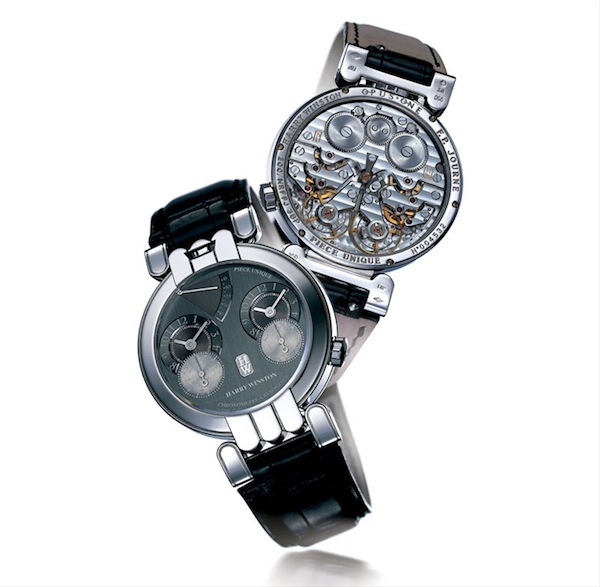
On May 30th, 2012 Christie's auction house in Hong Kong was host to the latest installment in their "Important Watches" auction series (which included a ton of watches). While this auction featured much of the normal fare from Panerai and Rolex, the main call for interest was an unparallelled representation of the Harry Winston Opus line. We have written of the Opus line in the past, but for those not in the know Opus is essentially a distinct line of Harry Winston timepieces which have been created in a collaborative partnership between Harry Winston and many of modern Horology's most talented independent watch makers. The concept behind the Opus collection comes from the powerhouse mind of Max Busser who ran Harry Winston's watch division before founding MB&F in 2004/2005. Harry Winston works with one independent watch maker per year to produce a limited edition watch which is then announced into the fan fare of BaselWorld. Though when the watches are actually released to customers is another story.

Last week's Hong Kong auction saw Christie's offer an unprecedented selection of the Opus catalog, including Opus 1 through 7 and Opus 9. In the end, auction goers may have suffered Opus-overload, as only six of the eight available pieces were sold - but that is actually still good. Apparently all the Opus watches came from one collector. Below is additional information on each piece that was available including a bit about their creation, estimated value and hammer price (if the reserve was met).


The Opus 1 - The first in the collection and the start of the Opus collaborations highlighting the work of F.P Journe. The Opus 1 was available in three editions, each being limited to six units. Including a 5 Day Automatic, a twin time Resonance Chronometer and a Tourbillon, the example seen at auction last week was the 5 Day Automatic with a diamond clad bezel. Given that the range offered only 18 total units it was surprising that the Opus 1 failed to sell despite estimates of $60,000 - $80,000 USD (lot 4837). Rare yes, but the design is 12 years old and tastes have changed a great deal since it was announced.


The Opus 2 - Featuring a 38mm platinum case and a total of two possible versions, the Opus 2 is the result of a collaboration with watchmaker Antoine Preziuso. The Opus 2 was limited to 11 units spanning two different movement options which additionally each had a special single unit adorned with diamonds for a total existence of just 24 hand-made pieces. Seen as both a tourbillon with retrograde calendar or as a fully exposed tourbillon, this auction was for a diamond clad version of the latter and saw estimates of $100,000 - $155,000. This extremely limited piece found a new home with a hammer price of $111,318 USD (lot 4581).


The Opus 3 - One of the most eccentric of the Opus collaborations, the Opus 3 is the brain child of Vianney Halter and features six porthole displays. Each of the displays relies on its own jumping indicator to show the hour in the top left and right windows (blue), minutes in lower left and right (black), and date in the vertical center displays (red). Limited to 55 units in platinum or rose gold, the Opus 3 featured a massively complex hand wound movement and an exceedingly unique aesthetic that was a considerable departure from the previous Opus models. This rose gold example did quite well at auction, surpassing the $75,000 - $150,000 estimates with a final price of $173,448 (lot 4877). This is actually quite good as the Opus 3 became a bit of a legend as it took 7 years to finally deliver the watches (in 2011).


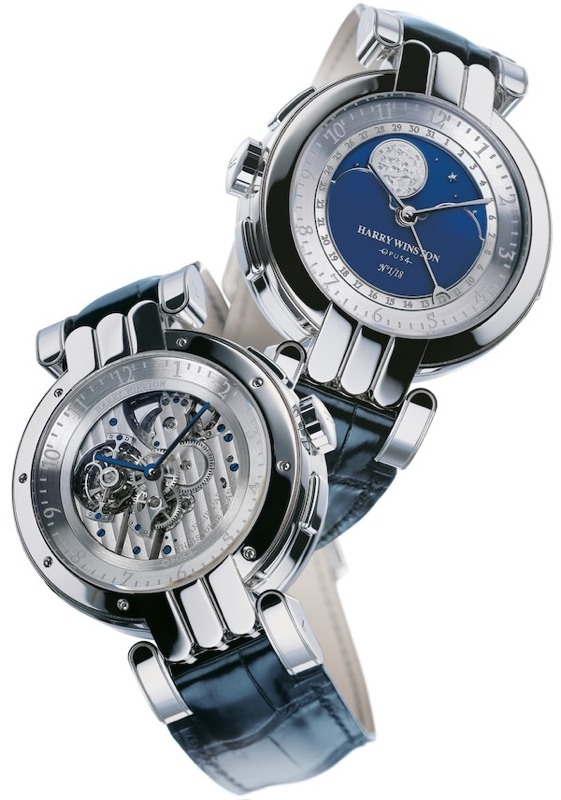
The Opus 4 - This dual-sided grand complication comes from none other than Christophe Claret (creator of the X-Trem-1 and 21 Blackjack). Featuring a tourbillon, minute repeater, moon phase and date all packed into a 44mm platinum case which can be worn with either dial facing up, it was surprising that this example of such a limited Opus (only 20 units made) would fail to find a buyer. A rare and unique watch like the Opus 4 likely needs a fairly rare and unique buyer, or perhaps the $150,000 - $200,000 estimated (and the corresponding reserve) was simply too high (lot 4987).


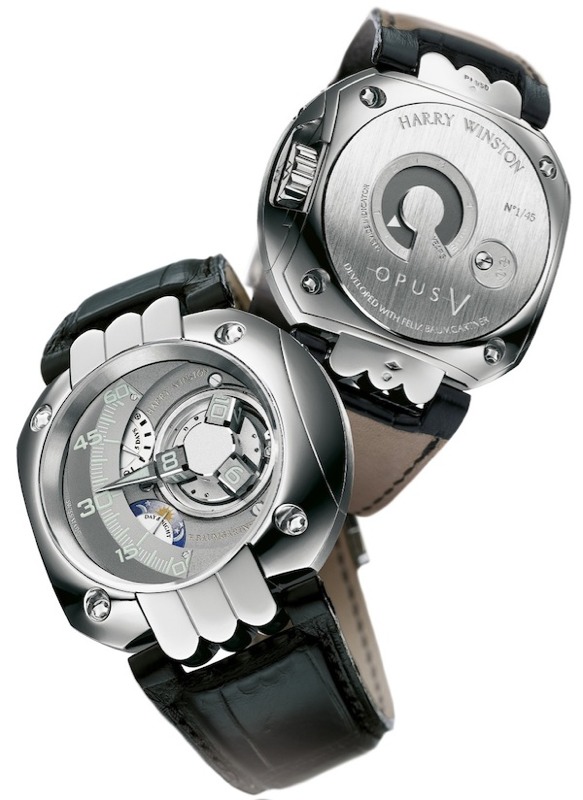
The Opus 5 - Announced at BaselWorld 2005, the dial and movement should be familiar to any fans of the Haute Horology brand, Urwerk. The Opus 5 came to Harry Winston by way of Urwerk's Felix Baumgartner and features their distinctive rotating satellite hour and retrograde minutes display. The Opus 5 stunned the watch world with its innovative time display, custom movement, and novel five year service indicator visible via the back of the watch. The auction offered a 2009 diamond-clad example of the Opus 5, which fell within the $155,000-$260,000 estimates by reaching a hammer price of $204,514 (lot 5033).


The Opus 6 - 2006 saw the announcement of the Opus 6, an absolutely gorgeous model whose dial could be the work of none other than Greubel Forsey. GF is a definitive force within the watchmaking world and the Opus 6 mixes their distinctive styling with a highly technical implementation of a double tourbillon featuring a fully hidden gear set so that the tourbillon appears to be completely separate from the mechanics of the watch. Independent co-axial discs separate the hours and minute displays from the seconds (at eleven), allowing ample space in the 44mm white gold case to show off the beautiful tourbillon movement. Limited to just six units, Christie's had something of an especially rare find on their hands and this example of the Opus 6 fell within the $330,000 - $520,000 estimate, finding a new owner for the impressive sum of $375,313 (lot 5122).


The Opus 7 - Born of a partnership with Andreas Strehler, the Harry Winston Opus 7 features no hands and is said to be inspired by butterflies. The 45mm white gold case features a hinged mechanical level for depressing the crown. A single press of the crown causes the rotation of a disc to display the hour reading, a second press displays the minutes and a final third press will show the remaining power reserve. This manually wound marvel was limited to 50 units and is one of my favorite of the Opus range as I love the circular patterns, the luxurious blend of white gold and blued steel, and the premise of a watch that demands interaction, a transaction between the watch and its owner must take place for the watch to render the time. Definitely not a daily wearer, but the Opus 7 has a certain toy-like quality that I very much appreciate. This example of the Opus 7 also fell within the $105,000 - $150,000 estimates with an end price of $119,084 (lot 5145).


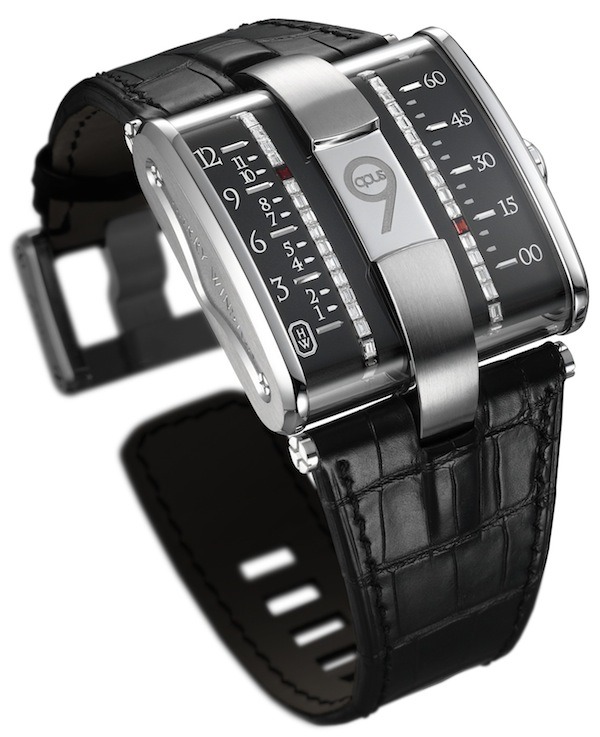
The Opus 9 - The Opus 9 is one of the more geeky looking designs to come out of the Opus program. Featuring a time display comprised of two belt driven and jewel encrusted scales that function as retrograde displays for hours (left) and minutes (right). Each belt is adorned with a diamond scale and employs a ruby in place of a pointer for each scale. This 45mm white gold watch is the product of the collaboration between not only Harry Winston but also watchmaker Jean-Marc Wiederrecht, and designer Eric Giroud and resulted in the Opus 9 winning the 2009 "Best Design Watch of the Year" from the Grand Prix d'Horlogerie. This example did quite well at auction reaching towards the ceiling of its $80,000 - $125,000 estimate, with a final price of $119,084 (lot 5171).

All things told, this was a very successful auction for Christie's and, with a final total of just over $21.5 million in sales, was actually the most valuable season for any auction house operating in Asia. Though it is important to recall that the auction as a whole offered hundreds of watches. Furthermore, with so few Opus models in existence, it is exciting to see how the prices stack up against the estimates as professionals try and predict the value of a very exclusive line of watches. All concerns for funding aside, I would have been aggressively bidding on the Opus 6 or waiting what could be a very long time for for Christie's to dig up an Opus 11, as it is definitely my favorite of the entire Opus family.

Chopard Classic Racing SuperFast Watches With In-House Movements


Chopard has had a really interesting last several years in terms of defining their brand and their release of new products. They benefit from not being part of a large group - which means they can experiment, play around, and sometimes just release cool things that aren't specifically meant for a target customer or demographic. As a watch writer, I have seen them spend time and money developing all sorts of interesting things - sometimes just for the hell of it. It basically means that I pay close attention to what they do because I don't always know what to expect.

For many people, Chopard is a brand that makes nice women's watches. You know, those timepieces with floating diamonds that the girls seem to really like. I actually like them too, but not enough to wear them like that one Singaporean guy I know. You know who you are Mr. "I blatantly wear a woman's watch." Anyway, for me Chopard is about their cool racing watches. And more recently also about their L.U.C collection pieces with in-house made movements. What you see here is a combination of those two worlds.


Chopard's racing themed watches are part of a few families. I am a bit confused by all the names, but they all seem to be part of the "Classic Racing" collection. That even seems to include very modern looking pieces like this one. So yes, the irony is that this non-retro watch is called the Classic Racing SuperFast (Super Fast). I just hope it doesn't run super fast. The majority of Classic Racing watches are in the Mille Miglia collection, while the rest are SuperFast, and Grand Prix de Monaco Historique pieces.

While I don't love each Classic Racing model Chopard releases, I am a fan of the majority of new stuff they come out with. I say that with seriousness, because I really love a lot of that stuff. Design and quality is mostly really good, and Chopard always ensures that comfort and legibility are design priorities. You'd be surprised at how many watch executives say things like "I don't use watches to tell the time." Great line of work for them... These Chopard Classic Racing watches as a whole have some of the best fit & finishing, as well as attention to detail, that is available. The biggest complaint people have with them is the price. Well, to be more precise, the price given the movement inside of them. The majority of these watches are chronographs and contain the tried and true Swiss ETA Valjoux 7750. These are top 7750s with mostly all COSC Chronometer ratings, but inherently are still movements which are widely available, and also come in many much less expensive watches. Most Mille Miglia chronograph pieces range from about $6,000 - $10,000. Which for many people is admittedly a lot for the 7750. As a watch lover I am still not 100% certain why people are so concerned about the movement as being the primary source of value in a watch, but it is often the case. What I mean is that when taking the price of a watch into consideration, people place an overwhelmingly large emphasis on the price of the movement. You need to take into consideration the case, dial, strap, and overall engineering costs. Nothing about these cases and dials says "inexpensive." Anyhow, Chopard is aware of all this and for a while has been planning the next step.


According to Chopard, there is a new factory next to where they make L.U.C movements, that will be used to make other not as technically complicated movements. Movements such as the Caliber 01.01-M and the 03.05-M which are contained in these three new SuperFast watches. The cases aren't new, and the overall style of these new for 2012 watches remains true to the existing SuperFast collection. Two of the pieces are about 45mm wide, while the three-hander is 42mm wide. You either love or don't love the case with its bulging screw bays and engraved vertical trenches on the side of the case and dial. The crown and pushers are coated with vulcanized rubber, and who doesn't like that little steering wheel in the crown? For 2012 the Classic Racing SuperFast watches with the in-house made Chopard movements are only available in 18k rose gold. I am told that next year steel cases will likely become available.

The Caliber 01.01-M automatic is used in both the three-hand and power reserve SuperFast models. Same movement, just two different configurations. The 03.05-M automatic is the new column-wheel chronograph. It has the same layout as the ETA 2894 it seems. The movement uses gray colored bridges with really neat cut lines to offer a grating look so that you can see through them to more of the mechanics. Of course the lines echo the style of the case and dial, and are yet another way of doing partial skeletonization.


While these movements aren't revolutionary in terms of technicity or function, they are made by Chopard. The brand can finally claim to have in-house movements in their more mainstream offerings, and if all goes well, these movements will be used in the majority of the Classic Racing collection. Of course it is impossible to ignore the shadow of ETA, who has been reducing their supply of movements to non Swatch Group brands. So Chopard is not only ensuring a source of movements for their watches moving forward, but is also providing an additional source of value for their customers. Look out soon for Chopard Classic Racing SuperFast watches with new in-house Caliber 01.01-M and 03.05-M movements soon. Prices on these pieces are over $20,000 because of the 18k rose gold cases, but will be less when the steel models arrive.

domingo, 3 de junio de 2012

JS Watch Frisland God Special Edition With Eyjafjallajökull Ashes


JS Watch Co. is Iceland's premier watch maker based out of Reykjavik. Though I can't say for sure if they are Iceland's only watch maker. As small brands go, they have done some nice things and their latest offering is a special product for them. It really takes the Icelandic heritage to a new level, combining a range of design features and cultural elements. This is the JS Watch Frisland God Special Edition timepiece.

Watch lovers will recognize a few elements that they have seen before. Good elements that bear repeating. The dial of the Frisland God watch is made from volcano ash. Which volcano? Oh you know which Volcano. None other than the now famous and still unpronounceable Eyjafjallajökull. Romain Jerome deserves credit for being the first brand to do a dial with ash from the Volcano after the little incident back in 2010. Over the black ash are printed hour indicators and text. It is hard to tell but the hands are actually rose gold (with applied luminant).


Using medieval (and prior) Iceland history, JS Watch came up with an attractive design to engrave all over the 42mm wide steel case of the Frisland God piece. According to the brand they spent a lot of time looking at old Icelandic artifacts for inspiration. On one side of the case is space for an engraving in the ancient Höfðaletur font. It says "Iceland" by default, but JS Watch recommends that each customer order a custom engraving (such as their name) to be spelled out in Höfðaletur (no, I don't know how to pronounce that either) text.

The obvious watches to compare this to are the engraved pieces from New Zealand watch maker Magrette. They have produced a number of watches with New Zealand Maori style engravings such as the Kupe's Voyage that I reviewed here a while back. Even the theme of the watches themselves are similar, combining art and a little retro sport aesthetics.


Inside the Frisland God watch is an automatic movement with a day and date complication. JS Watch doesn't indicate it as being Swiss, but I think that their other watches use Swiss movements - so it probably is. You can see that the automatic rotor is also nicely hand-engraved. The movement is actually a day/date movement with the day of the week indicator being closer to 9 o'clock. It sure doesn't look to be in English either. Maybe that is a special order. The strap that comes with the watch is Teju lizard skin, but an alligator strap is also available. Really a cool watch if you are into Icelandic or engraved items. A nice step for the brand that really does capture the culture and place they are from. Depending on the customized engraving, price will be between 9,000 - 10,000 Euros.


sábado, 2 de junio de 2012

Jaeger-LeCoultre Deep Sea Vintage Chronograph


El Memovox Deep Sea no necesita presentación. Más que cualquier otro reloj, esta pieza de vanguardia ha escrito uno de los primeros capítulos del submarinismo. Desde la aparición de esta disciplina deportiva en el trascurso de los años 1950, Jaeger-LeCoultre ofreció a los primeros exploradores de los fondos oceánicos, tanto a quienes buceaban con objetivos científicos como a aquellos que lo hacían con sed de descubrimiento, un guardatiempos que iba más allá de sus exigencias. En las diversas ejecuciones que se sucedieron hasta principios de la década de 1970, el MemovoxDeep Sea figura entre las raras creaciones relojeras que han marcado esta tipología. Deseosa de ofrecer a un público de amantes y apasionados la posibilidad de enlazar en su muñeca uno de los símbolos de su inagotable inventiva, la Manufactura Jaeger-LeCoultre propone notables interpretaciones de este legendario reloj. El formidable éxito alcanzado por el modelo desvelado el año pasado incitó a la Grande Maison del Valle de Joux a continuar en este rumbo.

En 2012, sale a la luz un nuevo reloj hermético inspirado en el Memoxvox Deep Sea, el Jaeger- LeCoultre Deep Sea Vintage Chronograph.
De absoluta fidelidad histórica, sus líneas son testigo de su noble ascendente deportivo. Con su caja de 40,5 mm, posee todas las cualidades que aceleran el corazón de cada uno de los amantes de la Alta Relojería.
Un bisel fijo rodea la esfera clásica color negro, protegida por un cristal de plexiglás. Los índices y las agujas de los minutos y de las horas centrales presentan un revestimiento de Superluminova de un cálido color anaranjado que evoca sutilmente el revestimiento luminiscente del Memovox Deep Sea de 1959. Los intervalos temporales medidos por el cronógrafo con dos pulsadores están indicados por dos contadores para las horas y los minutos situados a las 9 y a las 3 horas, así como por el segundero central. El fondo de la caja de acero inoxidable se ornamenta con el motivo grabado que ya aparecía en la pieza histórica, en el que se representa a un hombre-rana rodeado de burbujas. La pulsera de color negro realizada en piel de becerro estampado es idéntica, desde todo punto de vista, al brazalete que completaba el modelo original.
Así como la caja del Jaeger-LeCoultre Deep Sea Vintage Chronograph se inspira en los códigos estéticos de una realización emblemática, este reloj animado por el Calibre Jaeger-LeCoultre 751 G de cuerda automática integra los últimos desarrollos de la investigación Jaeger-LeCoultre, tales como el gran volante de inercia variable o los rodamientos de esfera de cerámica cuyo funcionamiento a largo plazo se asegura en ausencia de lubricación. El desempeño, la resistencia y la fiabilidad de la mecánica Jaeger- LeCoultre han hecho sus pruebas en el transcurso de los años y se conjugan con las cualidades que realzan la legitimidad histórica de un reloj hermético hasta 100 metros. De este modo, la última creación de la Grande Maison del Valle de Joux hará palpitar más fuerte el corazón de los amantes de las piezas legendarias que deseen rendir homenaje a una larga tradición de innovación en las disciplinas más diversas, con el confort y la fiabilidad que ofrece la última generación de Calibres Jaeger-LeCoultre. Deep Sea – un reloj legendario
En los años 50 no había norma alguna que definiese los criterios a los que debían responder los relojes de buceo. Aún no se hablaba del bisel giratorio unidireccional, de la resistencia a los golpes y a los campos magnéticos, ni de hermeticidad garantizada hasta 100 metros. En este ámbito todo estaba por hacer. Una simple evidencia requería que los índices y las agujas estuvieran dotados de un revestimiento luminiscente, algo que entonces se obtenía con el empleo del radio, para facilitar la lectura de las indicaciones en la penumbra, pero ninguna disposición legal protegía la definición “reloj de buceo”. No obstante, la ausencia de tal reglamentación implicaba numerosos peligros ya que para practicar esta actividad se requiere un guardatiempos absolutamente preciso y de excepcional fiabilidad. En efecto, en todo momento el buzo debía tener la seguridad de que sus tanques disponían de una reserva de oxígeno suficiente para las distintas paradas de descompresión que requiere la ascensión a la superficie. La legibilidad de las informaciones constituía, por consiguiente, una importancia crucial que el Memovox Deep Sea ya ofrecía en aquel entonces, por contar con una esfera de tal claridad que aún hoy responde a las más estrictas exigencias de los buzos. Sin embargo, como con relativa frecuencia los buzos pierden la noción del tiempo cuando evolucionan en el maravilloso corazón del mundo submarino, los relojeros de Jaeger-LeCoultre pensaron, ya en aquella época en la que los relojes de buceo daban sus primeros pasos, en dotar el Memovox Deep Sea con la función alarma, emblemática del Memovox. Los relojeros propusieron a los adeptos a este nuevo deporte una seguridad adicional mediante una alarma sonora suplementaria, cuya finalidad era indicarle al buzo que había llegado el momento de empezar su retorno progresivo a la superficie. Este signo de identidad y una prueba más de su extraordinaria fiabilidad marcó el triunfo del Memovox Deep Sea, y su edición original se agotó muy rápidamente. Desde entonces, muy pocos coleccionistas han tenido el privilegio de contemplar este legendario reloj. Sin embargo, motivados por su inquietud de no conservar sus realizaciones dentro de los muros de un museo y poner a disposición de los apasionados relojeros de hoy los innumerables inventos que jalonan su larga historia, atendió las solicitudes de los círculos de aficionados que reclamaban el renacimiento de este guardatiempos histórico. Así, en 2008 Jaeger-LeCoultre reveló una reedición del Memovox Polaris 1968. Este viaje a los orígenes continuó en 2011 con la reedición del mítico Memovox Deep Sea de 1959, el primer reloj de buceo equipado con alarma.
Hoy, esta creación interpreta con fuerza la estética del modelo histórico para transponerlo en un lenguaje formal contemporáneo, perfectamente acorde con las excepcionales prestaciones técnicas de su movimiento. Su lanzamiento el año pasado fue unánimemente acogido por los apasionados y amantes de relojes que han escrito un capítulo en la historia de la relojería y de la aventura humana.

Jaeger-LeCoultre Deep Sea Vintage Chronograph: características técnicas
Movimiento
• movimiento mecánico de carga automática, Calibre Jaeger-LeCoultre 751 G, producido, ensamblado y decorado a mano.
• 28.800 alternancias por hora
• 37 rubíes
• 5,72 mm de grosor
• 235 componentes
• 65 horas de reserva de marcha

Funciones
• horas, minutos, crono segundos, minutos y horas
• cronógrafo: contadores de las horas, minutos, segundero central

Esfera
• negra mate
• índices y agujas superluminova color “Tropic”

Caja
• acero
• diámetro 40,5 mm
• cristal de plexi
• hermeticidad: 10 bares

Pulsera
• piel negra con hebilla de hebijón de acero

Referencia:
• Q2068575