domingo, 27 de enero de 2013

Jaeger-LeCoultre Master Grande Tradition Gyrotourbillon 3 Jubilee Watch


At SIHH 2013 the most prestigious of the actually many prestigious new Jaeger-LeCoultre watches was a new version of the famous Gyrotourbillon. I don't think it is exactly what a lot of Gyrotourbillon fans were expecting given its return to a very classical demeanor and style, but it is a truly new Gyrotourbillon with some interesting features. As part of the master collection, this new piece is the Jaeger-LeCoultre Master Grande Tradition Gyrotourbillon 3 Jubilee watch.

The term "Jubilee" (anniversary celebration) is conspicuously in the watch's name even though Jaeger-LeCoultre doesn't mention any specific anniversary around the piece's release. If there was to be an anniversary it would be of the 180th anniversary of the beginning of what is today Jaeger-LeCoultre back in 1833. That is as much as I can surmise. The Master Grande Tradition Gyrotourbillon 3 Jubilee will be a limited edition of course, as slowly see production and possible variations over the years. What Jaeger-LeCoultre likes to do is take models like this and dress them up with diamonds in years after the piece's initial release. I saw that with the Gyrotourbillon a lot, but actually not at all or too much with Gyrotourbillon 2. While it is possible to place diamonds or other precious stones on most any timepiece, no matter how seemingly strange their placement, I do see the Gyrotourbillon 3 as a more "collector" oriented piece that seems to only have diamond-potential real estate on the case (thankfully not on the dial).


Now I mentioned that the Jubilee part of the name didn't make a ton of sense. That may be so but it does coincide with a small family of other Jaeger-LeCoultre watches that also bear the "Jubilee" name. These extremely complex classical watches are part of the ongoing honoring of Antoine LeCoultre. If you want to purchase the Master Grande Tradition Gyrotourbillon 3 now, you have just three changes and it comes with two other timepieces. It is sure to be a rather heavy investment. The set is the Jubilee Collection and sure to make your watch collection proud by angering your bank account.

75 more pieces of the limited edition set in platinum will be produced over time. More still will likely arrive in other precious metals. The case is generously sized at 43.5mm wide and 15.5mm thick, again what Jaeger-LeCoultre describes as "extra-white platinum. One area that they focus on quite a bit is the strap - more specifically the deployant. According to my friends at Jaeger-LeCoultre, this timepiece has about 100 pieces in the deployant alone. Giving it the ability to microadjust for comfort, especially as your wrist may expand or shrink given environmental influences.


So what exactly does the Gyrotourbillon 3 watch do? Well let's start by talking about the gyrotourbillon. It was originally developed by Eric Coudray for Jaeger-LeCoultre a few years ago. Mr. Coudray is a rather brilliant French watch maker who speaks not a word of English and appears to have never visited a barber. Though Mr. Coudray's steady hands are legendary and he is a very clever micro engineer. The gyrotourbillon is called as such because it appears to move like a gyroscope. Though in reality it is a two-axis tourbillon in a spherical shaped cage that is mystifying to view in action. The case is so delicate that most people who attempt to assemble the watch will break it. It is light and made from titanium and new for the gyrotourbillon 3 it has a spherical-shaped balance wheel inside of it. Imagine that. The ball-shape hairspring is a first for wrist watches, and truly completes the spheroid theme of this uber complication. No doubt it is clearly visible on the dial.

Borrowed from the Extreme Lab collection in the same brand, the Master Grande Tradition Gyrotourbillon 3 Jubilee watch also has a digital chronograph. Well a mechanical digital analog hybrid chronograph. If you see that counter in what looks like a subsidiary seconds dial then you are not seeing a big date indicator but rather a minute counter for the monopusher chronograph That subsidiary dial is the seconds register for the chronograph The watch does not offer the date nor a subsidiary seconds dial for the time as it appears to. Rather, this timepieces has the time in an off-centered dial, day/night indicator disc, and this unique chronograph. The marriage of these complications together is most likely unique, and it is truly something new. Ultra niche of course, but not necessarily intended to be practical beyond stimulating the horological region of watch lovers' brains.

While the Gyrotourbillon is not readily a Jaeger-LeCoultre at first look and is no doubt a whimsical timepieces, it does satisfy in a way that only Jager-LeCoultre timepieces can. As I will likely repeat in the future. They are among the only brands at SIHH 2013 to release even a new movement, and not just at this high-end range. For me JLC is currently an under appreciated brand (though fervent enthusiasts will deny that they contain somehow more appreciation somewhere), and is a true innovator in a space so frequently marked by sessility. jaeger-lecoultre.com


Technical details

Reference: 5036420
Case material: Platinum 950
Strap/bracelet: Alligator Leather

Jaeger-LeCoultre Calibre 176

Functions
Hour - Minute
Digital Instant Chronograph
Monopusher
Flying spherical tourbillon

Case - 43.5mm wide
Platinum 950
Water resistance : 5 bar

Dial
Silvered
Silvered opaline

Hands
Dauphines

Strap/bracelet
Alligator Leather

Buckle
Double Folding Buckle 20.0 mm

viernes, 25 de enero de 2013

De Bethune DB28 Skybridge Watch


De Bethune creates some of the most unique looking and distinctive watches on the market today. With a stellar aesthetic and standout case design, the new Skybridge is an interesting addition to their DB28 range of watches. The DB28 Skybridge employs the same skeletonized floating lugs and twelve o'clock crown placement seen on other models in the DB28 family, but offers a less complicated dial arrangement with an artful interpretation of the De Bethune design language.


The Skybridge offers a duality of modernism and elegance that has the look of a dressy Linde Werdelin, meant to be worn to a gala ball, on the moon. The Skybridge features a 43 mm polished titanium case with a 45 mm matched bezel. The case looks lovely but is entirely upstaged by the dial, also based in blued and polished titanium, which mimics a view of the night sky and is garnished with a selection of polished titanium balls (acting as mid-dial hour markers) and diamonds. There is a minute track surrounding the dial and a large conical design element intersecting the dial like an art deco spaceship. At the base of this "spaceship" is a small orb that functions as a very understated moon phase display. While I am hesitant to use the word "romantic", that is my genuine impression of the dial design for the Skybridge, and I love it. The ornate hands, the rich blue of the dial, and the charming dial design all make for a very compelling watch.

Mechanically speaking, the DB28 Skybridge is fairly straight forward. Running on the DB2105 in-house and hand-wound movement from De Bethune, the Skybridge has no seconds hand and no date, possibly because they would detract from the design. I have a hard time focusing on the time when I look at the Skybridge, evidenced by how I only just realized that the displayed time is 1:51 and not the more normally used 10:08. The DB2105 has 236 parts in its construction, including twin barrels and 27 jewels supporting a six day power reserve.

This is not De Bethune's first go at a watch with this overall look but I feel that the way in which they have minimized the impact of the time and moon phase display has allowed additional dial real estate (and visual attention) to be invested in the nature of the design. Not only will the DB28 Skybridge be a perfectly functional and reliable dress watch, but you have to assume there is a sense of occasion when you choose to wear a watch like this. While not a simple-looking watch, the De Bethune DB28 Skybridge does offer a distinctive and enchanting wrist presence that would be sure to rival anything else in your collection.

Richard Mille RM036 Watch With G-Force Meter


If you are a fan of Monty Python then you are a fan of comedy frequently derived from irony, and often from absurdity. Consider me such a fan, and I have a feeling that Mr. Mille falls into this same camp. At SIHH 2013 my enduring image of him is sitting in a chair and speaking energetically with his hands. "Absurdity" is the easiest way to explain the combination of features and the conception of the new Richard Mille RM036 "G-Sensor Tourbillon" watch.

In brief, the watch is a mechanical tourbillon-based timepiece with a g-force meter. On the one hand you have a rather fragile tourbillon escapement, and on the other hand you have a device designed to measure the force from velocity... typically used when you are planning on experiencing some rather high forces. These things simply don't go together most of the time.


In truth the RM036 is a beauty on the wrist. I've never been a closeted fan of Mr. Mille's spirited contraptions that are a result of an "I wonder if I can produce this mentality." Richard Mille attempted to prove in the past that his tourbillon watches could withstand the types of forces that would destroy most tourbillon-based movements. How did he do that? By placing such watches on the wrists of race car drivers, tennis players, runners, and golfers. All to be worn in the heat of competition. So these athletes did, and the watch purportedly survived - but perhaps that wasn't enough for Richard Mille to get his point across. In development for a few years, Richard Mille has just released a watch with a mechanical g-force meter. Cool. but what will I do with it? Well what I did do with it is test the g-force meter.

Holding the watch firmly in my hand, I tightened my fist and threw it to the side to see what would happen. Looking then at the watch dial I took notice of the g-force gauge on the top of the dial. The little hand which was once in the green was now in the red. All the way in the red. Looks like I just threw my wrist with enough force to kill a race car drive if his car was traveling at the same speed. I was impressed with myself. Unfortunately the gauge isn't specific as to how much force the watch just experienced. I support you need to trust that anything "in the red zone" is dangerous. A press on the pusher on the side of the case resets the hand for more actions to see what else the watch can endure.


I have to be frank with you, if I am planning on putting myself in a centrifuge or anything else that will compress my innards I don't plan on taking a tourbillon with me. It isn't particularly necessary to enjoy the almost romantic allure of that spinning escapement while the force of many Gs is convincing my stomach it is placed too low in my body. Richard Mille is also likely aware of this fact, but has seemingly long since forgot the notion that timepieces need to make much sense. In fact, the absolute frivolity of high-end watch design that market the mid 2000s is back with a vengeance. Only this time around it is much more limited in production and much more expensive. What used to be $200,000 in 2005 is $500,000 or more in 2013. But just a few pieces are all that is needed to get media and lots of excitement. Why does the RM036 exists? Because Richard Mille has the means, connections, and customers to make it so.


So why did they produce this watch? More or less for fast driving. The piece was made for Jean Todt, who is not actually a person who drives very fast (as far as I know). Todt is however involved with the world of motor sports in France and may be associated with the FIA Action for Road Safety. To be honest, the details from Richard Mille on the official purpose of the watch are scant and vague. Todt is a friend of Mille and perhaps the two thought the watch would be a fun idea. The brand refers to it as a timepiece designed to assist with road safety. The idea being that your watch tells you if you are accelerating too fast (and then what? You are going to slow down because your watch willed it?). Pretty sure our own bodies have ways of telling us that. Nevertheless, 15 of these watches will be made for you know... the safety of drivers, and their tourbillons.

Many Richard Mille watches are birthed at the Renaud & Papi headquarters. The watch movement designers there were tasked with coming up with a sufficiently small, sufficiently mechanical g-force meter to place inside of the watch. While this is the most interesting feature of the watch, it is one that Richard Mille explains the least. The RM036 has a gauge that looks a bit like a power reserve indicator on the dial that shows the maximum Gs experienced. A pusher at 9 o'clock resets the "G-Sensor" hand. So after driving really fast you can look at your wrist and giggle as you check out how close to the red zone you got. Unfortunately, the G-Sensor meter lacks any numerical values. So you'll simply have to take safety cues from the colors.


The RM036 Jean Todt G-Sensor watch comes in a 42.70mm wide titanium case with rubber strap. It is actually very light and supremely comfortable. If you are a fan of Richard Mille designs, then the watch is pure lust. The movement is manually wound and rather than pull out the crown, a pusher in the crown acts as a function selector (wind, set time, or neutral). With about 70 hours of power reserve, the movement has the time with a tourbillon that acts as the seconds indicator. There of course is also the matter of the G-Sensor which is a 17mm wide module that sits at the top of the movement.

If the RM036 is as durable as Richard Mille claims it to be, then we have another rather impressive piece of ludicrously over-engineered mechanical porn that certainly gets our wheels turning. Rather than the watch acting as a safety tool, I have a feeling that would-be racers with more money than good sense will use it to see how far they can make the needle go while rapidly braking their Lambos and Porsche's on the track. Richard Mille will produce just 15 pieces in this limited edition set of RM036 G-Sensor watches in titanium. Price is $490,000. richardmille.com

martes, 22 de enero de 2013

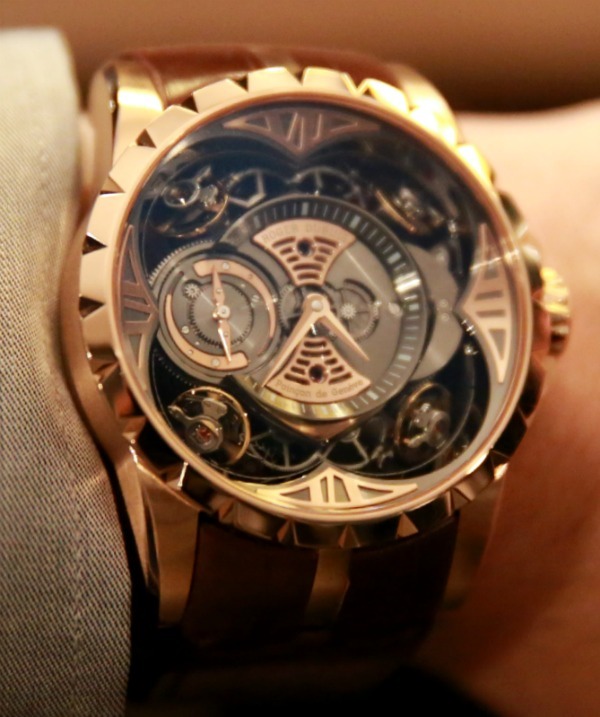
Roger Dubuis Excalibur Quatuor Watch


"Quatuor" is a name I can hardly pronounce but represents a piece of fun from Roger Dubuis that is wonderfully and most exquisitely deranged. Day one at SIHH 2013 is over and I am trying to wrap my mind around all the people I saw and faces I inadvertently forgot. Always good to reunite with friends and have strangers who seem to know you come up and ask how things are. I'd like to remove the "how are you?" question as a polite follow-up to "hello" during small talk conversations. It is all too generic. More a waste of time than a useful social ritual. How about something more interesting such as "was it difficult to choose what pants to wear today?" or perhaps "are you unhappy with your country's current leadership?" Yes, my mind was on all things save for timepieces. Of which there were scant few "novelties" at 2013's SIHH, but of course a few leaders in the "cool pack."

The show starts like a mimic of all the others. Practically all that is new is within the booths. Roger Dubuis is one of the few places whose booth is as worth seeing as the watches. While Roger Dubuis timepieces are prohibitively expensive for all but the most anti-frugal of budgets, I love their take on showy, light-hearted, and clearly theatrical luxury. This year's booth looks like some type of tree root-filled forest floor with a giant golden eagle in the center. Yes, an eagle produced specially for Roger Dubuis by a company that makes stuff for movie sets. There is also a man with an American bald eagle on his hand. An actual live bird that draws a crowd. The eagle is impressively calm, while a not-so-small fortune in watches rests behind it in the back office dungeons. The booth attendants are dressed like extras from Game of Thrones. I suddenly have no idea what any of this has to do with watches. And then Jean-Marc Pontroue, CEO of Roger Dubuis, shows me this incredibly weird watch box that opens up to the Quatuor.


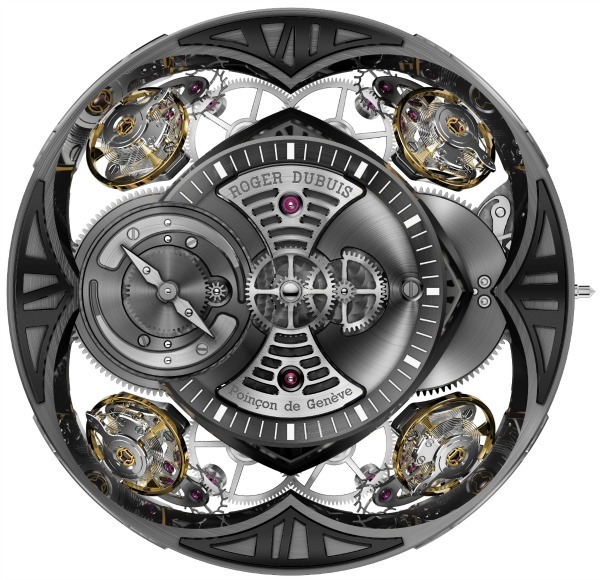
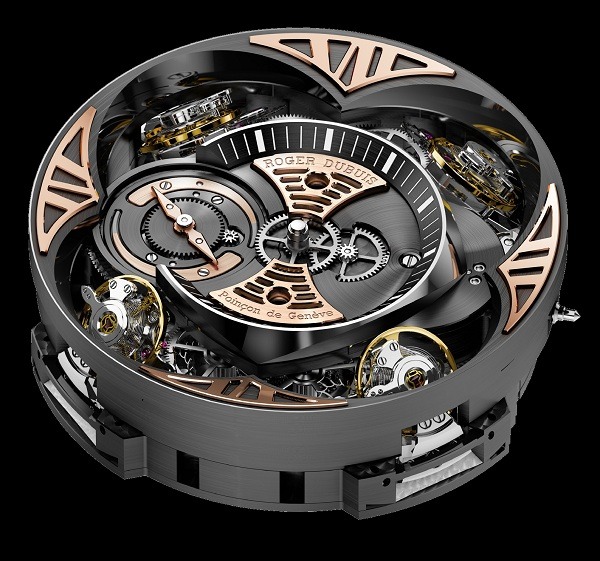
The watch has four diagonally positioned escapements (not tourbillons), that are connected in pairs by a series of differentials. These escapements average each other out theoretically - helping the watch to be more accurate. How accurate is neither an issue or concern as practicality is about as inherent to this watch as it is to the brand's booth design. The concept works, and that is all that matters. Sound from the four escapements running in unison is a hallmark of the Quatuor. Roger Dubuis haphazardly calls it a 16Hz watch. That seems to imply that by adding four 4Hz escapements together you equal 16Hz. I am not sure it works that way.

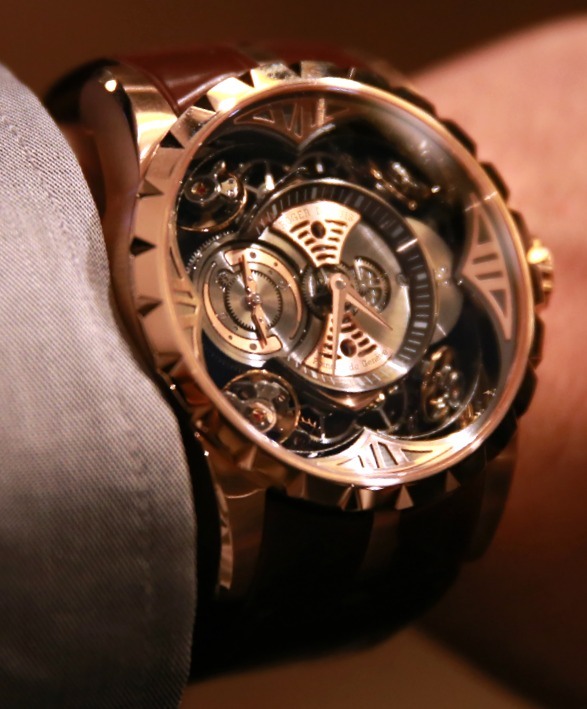
Set in the Roger Dubuis Excalibur case the Quatuor is large at 48mm wide. Its complex movement forces the watch to be thick, but in reality it is just as insane as your average neighborhood Roger Dubuis skeleton double tourbillon watch. The movement is strikingly symmetrical and beautiful in its design. According to a Roger Dubuis watch maker it takes a full 2-3 days to merely assemble the movement. Something like 2,400 hours are needed to build the watch from start to finish.


Designed by lead Roger Dubuis movement designer Gregory Bruttin, the caliber RD101 movement in the Quatuor is unlike most things you've seen before - even though it just shows the time. It almost feels like something in the Opus collection. The movement is comprised of almost 600 parts, and is deeply dark and rich in polished and other artistic techniques. It looks quite cool, but is unfortunately very difficult to photograph properly.

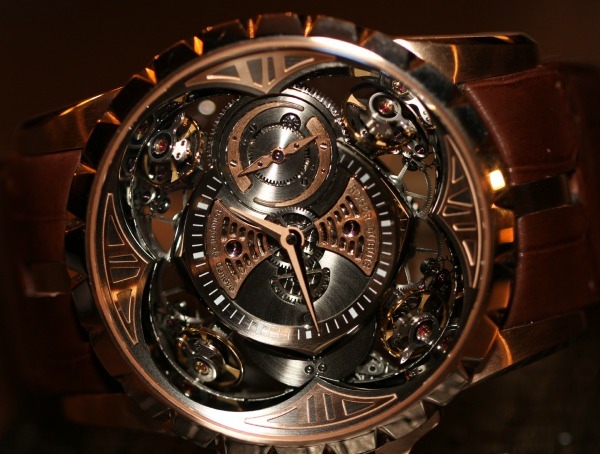
The four escapements running together act to help average out the rate results and amplitude of the movement. Put at diagonal angles facing into the dial they are quite beautiful to see. I think making this a quadruble tourbillon would have been too much. Even though there is so much going on where the dial is, it isn't hard to find the face of the watch to read the time.


According to Roger Dubuis the power reserve mechanism is new. It rotates once each 5 hours or so in combination with a normal hand. It is just that the normal hand has two sides to show the power reserve "twice." It is difficult to explain but the video helps illuminate how it works better. What advantages it have over "normal" power reserve indicators is a bit lost to me, but I was nevertheless impressed. I mentioned that Roger Dubuis watches are theatrical. The Quatuor is a good example in the already showy Excalibur collection.

At all angles the RD101 manually wound movement is beautiful. Seeing the constant movement of those four escapements is endearingly interesting although the timepiece is anything but quiet (visually and aesthetically). It is just the type of watch nerd candy people like me love. And Roger Dubuis made it for a simple love of the game. It is unique and special yes, and of course priced as such accordingly.


The final oddity about the Excalibur Quatuor watch collection is in the material of one of its versions. Both Quatuor models will be limited editions, the 18k red gold one to 88 pieces, but the other version to just three pieces. What is so special about it? Well it is actually made out of silicon. Yes, that material everyone has been so googly eyed about for years when it came to replacing metal parts in mechanical movements... made its way into a watch case (as the entire case). Now as far as I am told silicon is very scratch resistant. I can't personally attest to that, but it is light. Damn light. I picked up both silicon, titanium, and steel cases of the same volume and the silicon was by far the lightest, taking a dark gray almost gun metal hue. And it costs a fortune to machine properly. The limited edition of 88 pieces gold Roger Dubuis Excalibur Quatuor watch is around 350,000 Swiss Francs, while the silicon version (if I heard correctly) is about 2.2 million Swiss Francs. Crazy yes, but for a brand whose top seller in places such as the US is a double tourbillon with a skeletonized movement at a price over 200,000, creating something even more exclusive is simply what one does. Really an interesting concept in perfectly working and salable order, as well as a top choice timepiece that you'll never likely even get to touch. rogerdubuis.com


Tech specs from Roger Dubuis:

Excalibur Quatuor in Silicon
Case: 48 mm, silicon
Dial: Charcoal grey interior flange, white minute-circle transfers, charcoal grey engraved Roger Dubuis and Poinçon de Genève inscriptions, rhodium power-reserve indicator, black DLC hours and minutes hands, charcoal grey circular satin-finish exterior flange, black DLC appliques
Water resistance: 3 BAR (30 m)
Strap: Black, genuine alligator, hand-stitched
Clasp: Silicon adjustable folding buckle
Movement: Hand-wound movement, RD101
RD101
Hand-wound mechanical movement, 16 ¾’’’, 113 jewels,
finely adjusted in five positions, rhodium-plated, circulargrained
motif. Stamped with the Poinçon de Genève (certification in process)
Specific features
Hours, minutes, 5 differentials, 4 balance wheels, power reserve indicator.
Number of parts: 590
Height: 10.60 mm
Frequency: 4x4 Hz (28,800 vph)
Power reserve: 40 hours
Production: 3 pieces
Excalibur Quatuor in pink gold
Case: 48 mm, pink gold
Dial: Charcoal grey interior flange, white minute-circle transfers, Charcoal grey engraved Roger Dubuis and Poinçon de Genève inscriptions, pink gold power-reserve indicator, pink gold hours and minutes hands, Charcoal grey circular satin-finish exterior flange, pink gold appliques
Water resistance: 3 BAR (30 m)
Strap: Brown, genuine alligator, hand-stitched
Clasp: Pink gold adjustable folding buckle
Movement: Hand-wound movement, RD101
RD101
Hand-wound mechanical movement, 16 ¾’’’, 113 jewels, finely adjusted in five positions, rhodium-plated, circulargrained motif. Stamped with the Poinçon de Genève (certification in process)
Specific features
Hours, minutes, 5 differentials, 4 Balance wheels, Power reserve indicator.
Number of parts: 590
Height: 10.60 mm
Frequency: 4x4 Hz (28,800 vph)
Power reserve: 40 hours
Production: 88 pieces

lunes, 21 de enero de 2013

Bremont HMS Victory Watch


Joking around with the ever-charming guys from Bremont I snapped some pictures of the limited edition HMS Victory timepiece. While still new to the watch game the guys at Bremont are quickly figuring out what it takes to be a major player in the industry and all the fun stuff, as well as BS, that goes along with it. More so than even other similar brands Bremont's production is split between two separate types of products, even though they are related when it comes to design and execution.

First are the non-limited or mainstream watches. These are the pieces anyone can buy at anytime. Then there are the limited editions available either as just a limited run of pieces or as a limited run of pieces that only a select group of people or club can buy (think special watch series for some Air Force squadron). It is difficult to determine which type of product Bremont is focusing on more, or rather what they feel is important to them. The brand is still comprised of a relatively small team, so they aren't really too focused on totally new models and new limited edition pieces at the same time. For 2012 the bulk of their attention seemed to be on the HMS Victory watch.


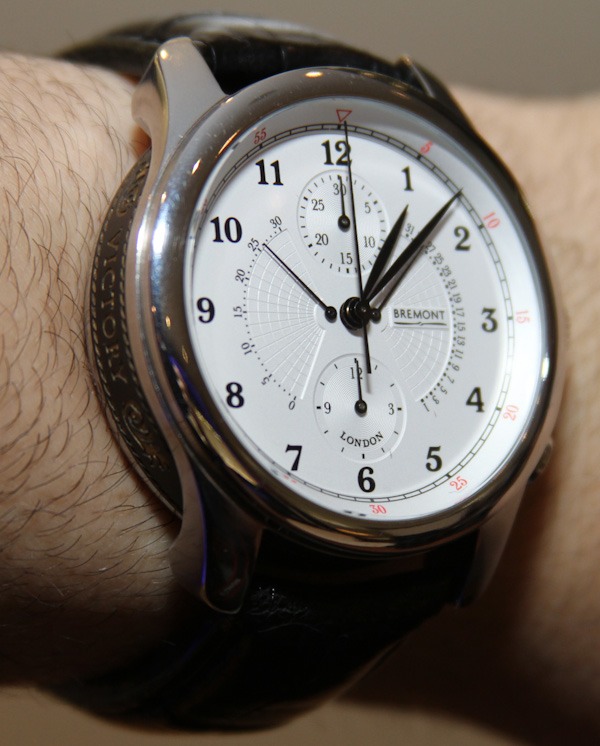
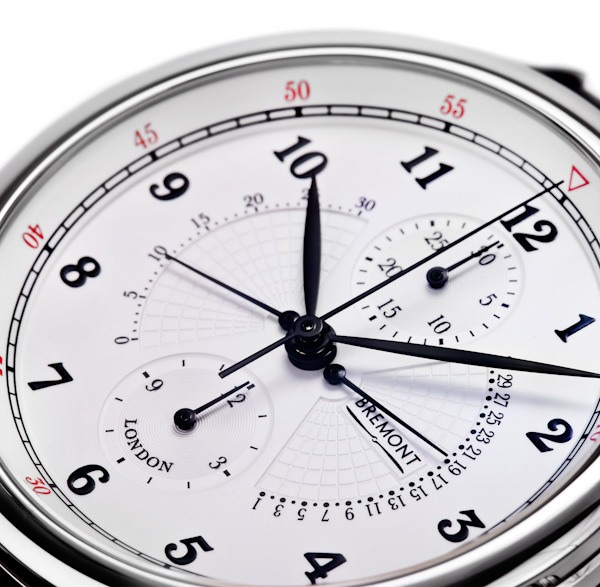
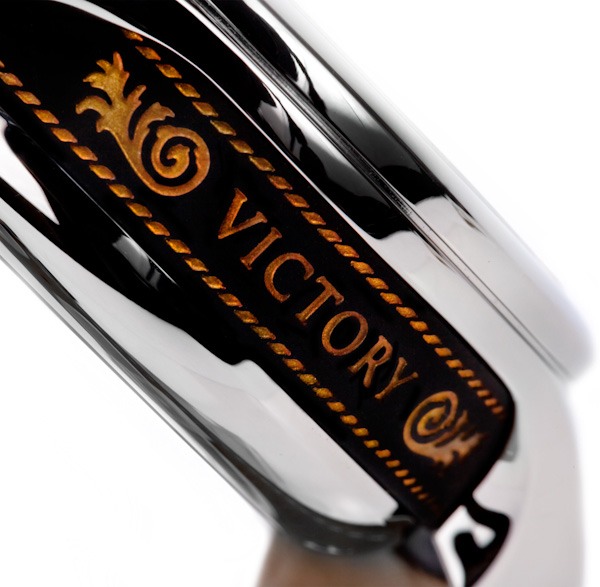
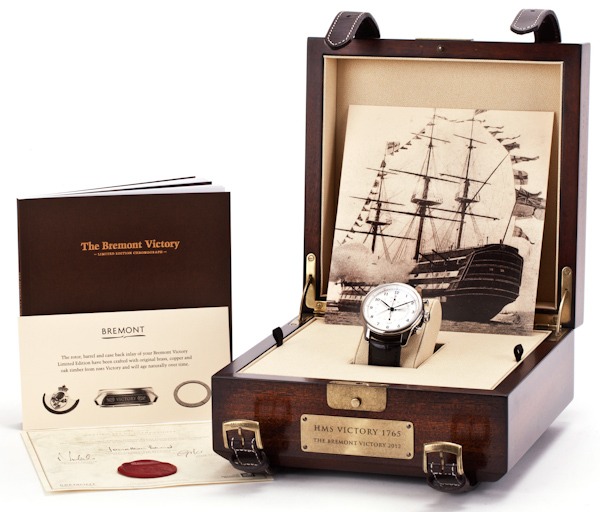
I've got two sets of pictures for you here, and both are important. First are my hands-on pictures of a PROTOTYPE version of the Victory that has been around the block enough times. These are versions made before a full production and are typically not visually complete or with the right finishes. This prototype watch has a lot of things not finished with it that are done on the final piece, which is what the second set of pictures are of. Thanks to Bremont retailer The Watch Gallery UK, we have these sexy shmexy images of the all-done Victory watch complete wit proper case details and that amazing caseback and rotor.

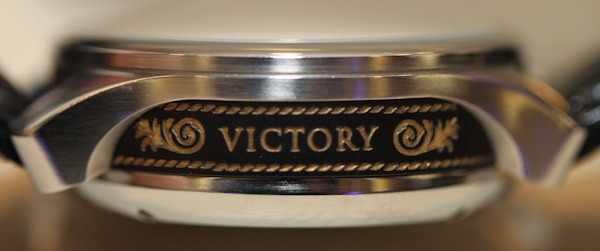
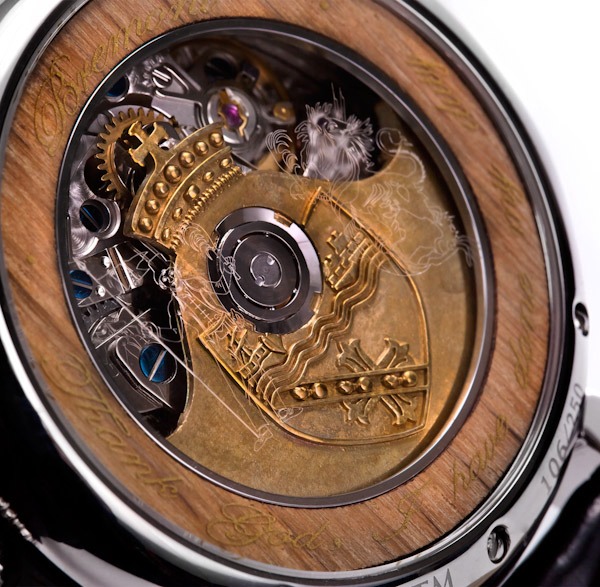
Let's just skip to that rotor and caseback shall we... I am no Horatio Nelson or HMS Victory ship historian, but the watch is full of imagery dedications to the two. As you'll recall from my first piece Debuting the Bremont HMS Victory watch last year here, I mentioned how the timepiece had wood from the actual ship as well as metal from actual nails taken from the ship. You can see all of that on the back of the watch. There is the wood ring about the exhibition caseback window, and metal from the historic war ships' nails in, I believe, the rotor, case middle barrel, or perhaps both.


The historical looking design of the automatic rotor mixed with the etchings on the sapphire crystal and Nelson's message around the wooden right are pretty darn cool. In a sense it is amusingly over the top as well, intended for serious watch and history buffs. The quote from Nelson reads "Thank God, I have done my duty." It is an almost masturbatory celebration of the famous Brit and his naval achievements. Would you have it any other way? Once someone decides to honor something in a limited edition watch the tendency is to take it as far as one can. That's just human nature.

Part of the point of the HMS Victory watch is to benefit the restoration and upkeep of maintaining the actual HMS Victory ship. The 18th century warship is the last of its kind and as a historic monument always needs cash to survive. This project will deliver financial assistance to that cause.


I just realized that this watch has nothing to do with Bremont's aviation theme. It does however have a lot to do with Bremont's British theme. As a pilot watch brand Bremont has an uphill battle fighting greats such as IWC and Breitling. As a primarily British heritage and pilot watch brand they place themselves in a new class. The best part is that it isn't a PR show. Bremont is started by and run by the English. They also plan to move as much as of their production to the UK from Switzerland as possible moving forward, as they continue to reinvest in themselves. Those are some handsome goals, and among fellow English watch brands Bremont is typically seen as a leader of the pack.

The ship's clock style dial of the HMS Victory watch is benefited by black on white hands and a clear symmetrical look. The functions are built on top of a base Swiss ETA Valjoux 7750 automatic movement. They modify the subsidiary seconds hand to be a 30 second retrograde hand, and turn the date indicator into a retrograde hand as well. The resulting operations are both logical and attractive. Though the module on top of the already thick 7750 make for a rather thick timepieces.


The HMS Victory watch is 43mm wide available in steel or 18k rose gold. Each version is limited to just 250 pieces and comes in a pretty sweet collector's box, with... is that watch strap buckles to close it? On the wrist it is conservative-cool and historical feeling (and looking). It is going to make a number of mature watch collector's super proud. Bremont is doing their job today pretty well, When you look at their pieces you think, London, planes, and now ass-kicking admirals. Prices are high through. The Bremont Victory watch in steel is about $20,000 and about $30,000 in gold. According to Bremont they are all sold out, but I have a feeling that means to retailers. So get em while they are hot.