sábado, 9 de febrero de 2013

Montblanc Timewalker World Time Hemispheres Watch


We wore a new Montblanc Timewalker model for a little while during SIHH, so we thought you should know a little bit about it. There seems to have been a resurgence in world-timer watches these days among many brands. In many ways this is understandable given the increasingly global nature of our world. No longer is the simple GMT adequate anymore. Knowing only two time-zones is so passé when world-timers offer the possibility of reading off all the time-zones of the world at one glance. Well all of the "normal" timezones. We like to conveniently forget the dozen or so places who deem it necessary to cut the hours up.

Montblanc's latest Timewalker watch is the World Time Hemispheres and enters into this crowded field, with a few quirky features that set it apart.


Now before I start, I wish to relate a rather embarrassing story connected to this watch. So hear me out, and let me get it out of the way right now.

I received this Montblanc Timewalker World Time Hemispheres from ABTW editor Ariel Adams at the SIHH. Since I have always been partial to world-timers I immediately jumped on it. It was when I wanted to set the time that I ran into a problem. Looking at the cities around the dial, I was unable to find my reference city of London.

No biggie I thought. Some other city on the dial would probably be the same as GMT. However when I looked closer, I saw some cities that I recognized, and many others that I had not heard of before. Without knowing these strange cities, I was unable to figure out the GMT time. Embarrassing for sure.


Now I have to say that I received this watch with no information about it, not even the name. Having seen and handled many world-timers before, I could not allow myself to admit that I did not understand this watch. I handed it to Ariel, who spent some time with it, and he too was unable to figure it out (though admittedly it had been a long day).

Some hours later, I noticed the country near 11'o clock looked like Australia, then realized that all the cities around the flange, (or at least those I knew) were in the Southern Hemisphere, plus the fact that the words "Southern Hemisphere" is printed right there on the dial. We put two and two together and finally figured out how to read and set the watch. Next time we will let Montblanc and other brands brief us before getting into new pieces.

Now, I've spent some time relating this story for a very good reason, and that is, that this particular model, the Southern Hemisphere version, won't really be very easy to use as a world-timer if you've been familiar with other world timers before.

In fact I did not realize that Montblanc had released this watch in two versions, The "Northern Hemisphere" and the "Southern Hemisphere." I had been given the Southern Hemisphere one and that was the reason for my difficulties. Note that the Time Walker Hemisphere's Southern Hemisphere will be the less produced of the two models.


You see, the Northern Hemisphere versions contain the more traditionally known cities that adorn the dials of most world-timers, cities like London, New York and Tokyo. If this was the version I had received first, this review would be very different. When meeting with Montblanc CEO Lutz Bethge, Ariel asked what this was all about. Lutz, with his typical warm smile and child-like sense of fun simply returned "it was something different, we didn't want to do the same thing as everyone else."

As it stands by itself, it is an interesting concept to divide the two versions into Northern and Southern Hemispheres. However, that I was given the Southern Hemisphere version without knowing anything about it, and facing the problems I did, really brings to light the fact that most world-timers are northern hemisphere-centric. I certainly did not know that, and if you want a world-timer with a different list of cities than every other, then this one should be right up there on your list.

Whichever version you choose, you will be able to see the reference cities of the sister version engraved on the case-back at the corresponding locations on the dial. This is a nice touch that anchors the relationship between the two. Note that on the rear of the watch is a guide of the traditional 24 hour reference cities that helps you reclaim your ability to use the watch. We just needed to peel aside a few stickers to discover that.


My comments on the watch however, only apply to the Southern Hemisphere version as this is the version under review.

So how does it fare as a world-timer? Disregarding the need to re-learn the associated cities with your time zone, I would say, not terrible, but it could be a bit better. The key thing that lets it down is the fact that the rotating 24 hour ring around the center is a little too small. As far as usability goes, it's difficult to make out the exact hour associated with your city. If however, all you need is to see if it is day or night in the timezone of your choice, then I suppose that it should work quite well.

Also, take note that unlike many other world timers the city ring does not move, which is a further disappointment. It would have been nice if it were possible to get my reference city at any place that I wanted, but it is what it is. The city ring is actually a reworked GMT hand. So while it is independently set, it offers a little less user friendliness than traditional world timers. Having said that, it is also less expensive.

This particular model is in stainless steel and titanium which makes the watch feel lighter than it looks. The bezel brushed titanium while the case is polished steel. A moderately flat case at 43mm means that this watch sits close to your wrist and feels very comfortable. I've never been particularly partial to the case design of the Timewalker series, with its skeleton lugs and thin bezel coming across a little too architectural for me. However, I can see how the design holds together and for that I put it down to a matter of personal preference. Ariel on the other hand is a known lover of the Timewalker collection design. We can both agree that it is quite comfortable.

This Southern Hemisphere model comes with a grey toned dial with orange and white accents and a view of the earth from the South. I would have preferred this to come with a white dial, like the one on the Northern Hemisphere model. It would have certainly helped in terms of legibility, as I found that the grey and silver accents tended to blend into one another at certain angles, making the watch a little difficult to read quickly.


Having said that, the spaciousness of the dial, helped by the thin bezel, really gives a sense of lightness to the watch, which emphasizes the vastness of real space depicted. One really gets a sense of looking up (or down with the Northern model) at the earth. Having said that, legibility of the time is quite good.

All in all, it's a bit of a quirky choice, and something of a mixed bag. I much prefer the Northern Hemisphere model in terms of the color scheme, overall usability and legibility. Plus the fact that it, unlike the Southern with its stainless steel and titanium bracelet, the Northern comes with a black calfskin strap with blue stitching which is a bit more modern and cool. Inside the watch is a modified base Swiss ETA automatic movement. Prices for the Montblanc Timewalker World Time Hemispheres start at $4,900 for the watch on a strap up to $5,700 on a bracelet. montblanc.com

Necessary Data
>Brand: Montblanc
>Model: Time Walk Word Time Hemispheres
>Price: $5,700 as reviewed
>Would reviewer personally wear it: No, prefers other Timewalker models.
>Friend we'd recommend it to first: Someone with a loyal brand affinity to Montblanc who simply must have a world timer for around $5,000.
>Best characteristic of watch: The Timewalker case and design never seems to get old, and the Hemisphere's concept is amusing.
>Worst characteristic of watch: Too much a variation on a GMT movement without a city ring adjuster and a world time ring that is a bit too hard to read given its thin size.

viernes, 8 de febrero de 2013

Ball Engineer Hydrocarbon NEDU Diver’s Watch


Ball released an interesting new diver called the Engineer Hydrocarbon NEDU. The Navy Experimental Diving Unit (NEDU) is the branch of the American Navy that deals with the standards for operational diving and decompression rules for their divers. NEDU is actually the group responsible for establishing the decompression tables you may know from scuba training or, if you're like me, from the rubber strap that came fitted to a Citizen Aqualand diver. These decompression tables allow a diver to know how quickly to ascend, based on the duration and depth of their dive. Use these numbers correctly and you can prevent suffering a case of the bends.


Back to the watch at hand. The NEDU is a 42mm titanium diver that features Ball's signature H3 micro gas tubes for constant low-light illumination and is powered by a COSC certified ETA 7750 automatic chronograph movement. The 7750 offers hours, minutes, sub seconds, day and date along with a central seconds hand for the chronograph measure and a maximum resolution of 12 hours. A COSC 7750 is a rock-solid choice for a sports chronograph as the movement has proven to be reliable, capable of excellent accuracy, and generally cheap to repair or service (compared against in-house movements).


The 21 micro gas tubes, a 3.7mm anti-reflective sapphire crystal, and 600m worth of water resistance do not make the the NEDU a slim watch. With a thickness of 17.3mm, even the titanium construction of the case cannot save this watch from a large and weighty footprint. Unlikely to fit under any cuff, the included titanium and steel bracelet does sport an extension so the NEDU will fit over your wetsuit. Further features include a lumed ceramic unidirectional bezel, 7500Gs worth of shock resistance, and magnetic resistance to 4,800 A/m. Perhaps most notable is that Ball has managed to integrate an automatic helium escape valve into the crown of the NEDU diver. The Hydrocarbon range sports an over-sized crown and propriety locking system, so why not use the available space for an HEV? The spring based system, believed to be a watchmaking first, is fitted into the cap of the crown and allows expanding helium molecules (accumulated during saturation diving) to leave the case of the watch without damaging any components.


The Ball Hydrocarbon Engineer NEDU will be available soon with a list price of $4,950 USD. We like Ball for their attractive designs, good build quality and because of our child-like fascination with anything that glows in the dark. While a crown-integrated HEV may not be a considerable improvement over past implementations, we like that Ball is developing new ideas and bringing them to market. The NEDU is yet another example from Ball of an unconventional design (both aesthetically and technologically) that leverages Ball's strengths and innovative spirit. ballwatchusa.com

jueves, 7 de febrero de 2013

Cartier Tortue XXL Multiple Time Zones Watch


Cartier, an essential name in the luxury watch world, announced a series of 2013 novelties at SIHH this year. Among the fray is the interesting and notable Tortue XXL Multiple Time Zones watch. Available in either pink or white gold, the Tortue XXL world timer offers what at first may seem like a fairly conventional GMT complication until you view the watch from its side. Along its left flank, Cartier has fitted a small window which allows the user to view a selectable range of cities and define their desired local timezone.


A pusher located at two o'clock is used to cycle through the available timezones (based on the standard city) and the watch will even offer the distinction between summer and winter time by displaying a tiered layout that references the seasonal setting of both north and south hemispheres. Ariel saw the Tortue XXL in person and confirmed that the city select feature could be managed without removing the watch from your wrist. Home time is displayed on the lower sub dial and Cartier has forgone the usual 24 hour dial, opting to employ a daylight hand (featuring a sun) and a night hand (featuring a moon). This is a much more elegant way to display the same information in less space and allows additional real estate for the world illustration to be included in the dial design.


The movement is the Cartier caliber 9914 MC which features 283 parts, 27 jewels and a power reserve of 48 hours. This innovative in-house movement allows the Tortue XXL to offer the more simple dial layout of a two timezone watch, while still packing the punch of a selectable multi zone complication. The 9914 MC is an automatically wound movement and can be viewed via the Tortue XXL's display case back. Cartier doesn't use "XXL" lightly as the Tortue XXL measures a whopping 51 mm long, 45.6 mm wide, and 17.2 mm thick, making it very large for a watch with such a dressy vibe. You can see from the included wrist shots that the Tortue XXL wears large and has a rather flashy wrist presence.


This is a surprisingly tight design from Cartier and should make for a strong competitor in its segment. The movement is the essentially the same as the one used in Cartier's Calibre Multiple Time Zone Watch but it has grown up a bit and they have dropped the gimmicky complication for measuring your jet lag. The resulting dial design is legible, ornate, and still distinctly Cartier. The dial exhibits a not-too-flashy world design to suggest the watches true capabilities while still allowing ample space for the roman numerals and multiple timezone display. Cartier made a wise decision in keeping the main dial design as straightforward as possible, with the time zone selector window on the case side, more of the dial can be devoted to information you need most frequently. For a high end and fairly complicated Cartier, this design works really well.


Novelties don't come cheap and the Cartier Tortue XXL in white gold will sport a list price of $46,200 with the pink gold weighing in at $43,100 USD. That may very well be chump change for the jet lagged globe trotters among us, but price tags like that is what SIHH is all about. The Tortue XXL is yet another notable model from brand that, despite often going their own way, has carved out an enviable and recognizable position in the luxury watch game. Do you think Cartier a reached a point where they are a serious choice in the $30,000 plus segment? cartier.com

Laurent Ferrier Galet Classic Micro-Rotor Automatic Watch


A former Patek Philippe watch maker as I recall, Laurent Ferrier set up shop making his own watches a few years ago under his own name. His first watch was the rather impressive (and award winning) Galet Classic Double Balance Spring Tourbillon. It won him a prize at the GPHG 2010. Following the Tourbillon, he began to develop and eventually produce an automatic, and a while ago I took some hands on images of it. While Laurent Ferrier watches aren't for everyone, in my opinion they are among the finest "classic" timepieces available with marvelously meticulous designs that don't compromise and very attractive in-house made movements. If you want a conservative watch from an independent watch maker, something from Laurent Ferrier just might be for you.

Mr. Ferrier is bespectacled older fellow who speaks not a word of English. You can tell that he has a lot to say about his timepieces if he can communicate that to you in French. In fact, it matters little whether or not you know French because he will tell you anyways. "Galet" means pebble actually, and it is a term applied to a range of watches that have been produced over the years. The idea being that the case is smooth and polished like a stone. It is true, and in a quasi-Rolex design, the Galet Classic case at 40mm wide and 10.7mm thick feels perfectly polished both visually and by touch.


As far as I know, no Laurent Ferrier watches are available in steel. You get gold or platinum choices only. And if that doesn't fancy you then I believe he has other customers waiting. What first drew my attention to his designs was the watchmaker's touch. Such as the proper proportions on the dial, the fluid ergonomics, the highly detailed and well decorated movement, and a concept of what watch collectors like.

This automatic version is called the Galet Classic Micro-Rotor. It actually exists as a lower-price alternative to the tourbillon (go figure). While I prefer an automatic movement, I actually prefer the dial of the Double Balance Spring Tourbillon. The Micro-Rotor's dial is a bit more 1950s-1960s, but you do get Ferrier's signature long and thin hour markers and hands, as well as subsidiary seconds dial. The movement is called the FBN caliber 229.01. Aside from the solid gold micro-rotor, its most notable feature is the use of a double balance spring.


These two balance springs alternate in their beat, and you need to look closely to see them. These are known as double direct impulse balance springs and they use a silicon lever in this movement. The idea is that they are meant to cancel out each other's errors to produce a more consistent timing in the movement. The rate of the movement is 21,600 vph, and it has a power reserve of three days. Decoratively, the Micro-Rotor's movement is gorgeous. Lots of fantastic polished, beveled edges, and an attention to detail you find only in top-grade movements.

There is also a beautiful depth to the movement. Rather than try to be ultra-thin, the 229.01 is 4.35mm thick (actually not that thick), but it makes room for you to look inside of the movement and admire all of the parts. While not the world's most complex movement, it is hand finished, limited in production, and very beautiful. Together it feels quite satisfying indeed. Oh, and the movements are COSC certified chronometers.


Laurent Ferrier offers a few dial variations of the Galet Classic Micro-Rotor from a brush slate dial to one in a silver tone. Again, while they are quite attractive, I find them less engaging than the very beautiful enamel dials of the tourbillon. Which actually is a rare timepiece with Roman numerals that I like. Still, the dials on the Micro-Rotor should satisfy most. I bet they would customize one for you as well if you asked.

Attached to the Laurent Ferrier watch is a handsome thick reptile strap. The timepiece is dripping with a classy sense of old world perfection. It is more designer than any Patek Philippe, yet so much more restrained than most designer watches. Nevertheless, given the price, movement design, and provenance, you'll need to be a seasoned timepiece aficionado to completely appreciate the watch. Price is 49,000 Swiss Francs.


--------------------------------------

Puedes encontrar más material relacionado al presente, en nuestros Blog

Gestión y Dirección de Empresas Familiares http://gestiondeempresasfamiliares.blogspot.com

Gestion de PYMES
http://gestiondepymes.over-blog.com

sábado, 2 de febrero de 2013

Raymond Weil Maestro Automatic Moon Phase Watch


In most engineering fields and resulting products, complexity is a nasty evil that pops up at inopportune times and usually needs to be curbed and eliminated. In the world of fine timepiece craftsmanship, complexity, the right kind, is highly valued and cherished. Complicated watches from top brands that include calendars, astronomical charts, power reserve indicators, and so on, are prized collector's items.

Of course, a side effect of complicated watches is that they may require more frequent maintenance and are on the very top price range of an already high-priced market for Swiss made watches. One brand that is trying to break the mold is Raymond Weil (RW). Part of their mission is to create classically designed watches with various complications while keeping prices in the affordable range. A good example is the Raymond Weil Maestro Automatic Moon Phase which also includes day, date, and month complications.


Raymond Weil names its watch lines after musical-related monikers. The Maestro line was introduced in 2010 in advanced celebration of Raymond Weil's 35th year anniversary since they started operating in Geneva in 1976. Many of the watches in the Maestro line are essentially RW's version of classic round watches with guilloché dials and various calendar-related complications.

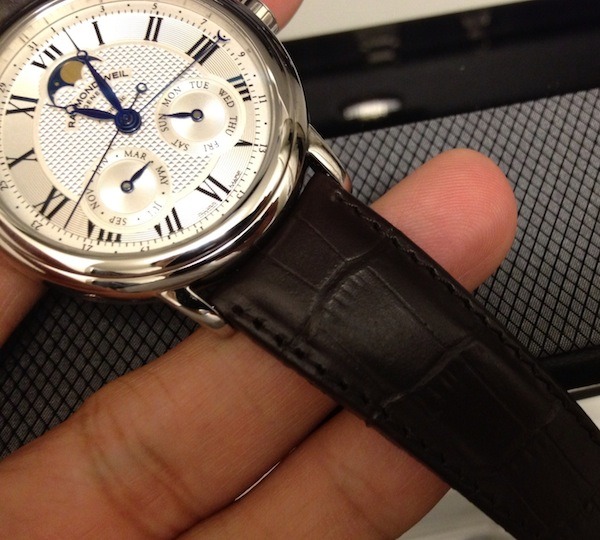
The Maestro Automatic Moon Phase reference 2849-STC-00659 is a relatively small watch by today's standards. Its 39.5mm wide polished stainless steel case measures 11mm high. It's also a light watch at just 70 grams. The brown leather strap with alligator pattern starts at 20mm and narrows to 16mm with a polished steel tang buckle that is inscribed with the Raymond Weil name.


My favorite part of this watch is the beautiful dial which is visible through a flat sapphire crystal with anti-reflective coating on both sides. The dial's color is silver with a central round guilloché pattern that contains a month subdial between 7 and 8 o'clock and a symmetrical day subdial between 4 and 5 o'clock. Both subdials have a fine radiating pattern that ends with the abbreviation for months and days and a small blue steel hand indicator.

At 12 o'clock is a half quadrant that serves as the moon phase indicator. The moon shows in gold on a blue background that includes gold stars when the moon is in its crescent and new phases. The dial includes roman numeral markers in black for the hours and at the edge a full calendar of dates showing the odd numbers and ending in 31 at 12 o'clock. In a nutshell, it is both attractively symmetrical and legible in its design.


The dial is completed with hours and minutes blue steel hands and a hair thin seconds hand. The current date is shown by an additional hand that ends with a half circle and moves in steps every day, half-encircling the current date. The hands have the classical "clous de Paris" design style with the hours and minute hands including a hollow circle close to the tip that becomes thinner to better show the current hour and minute. The dial is brilliantly executed, reminding one of Breguet-style calendar watches... Or you can think of it as "baby-Breguet" or "Breguet-light" ("Diet Breguet? if you may).


The automatic movement inside the watch is an RW 4600 caliber which is a modified ETA 2824 movement to include day, month, and moon phase complications. The transparent case back shows the sparsely decorated movement. The automatic rotor includes the caliber number and the RW name.

Adjusting the day, date, month, and moon phase is done via flattened pushers at 2, 4, 8, and 10 o'clock. To simplify this process, RW includes a small stainless steel pin that has a tip perfectly sized for the pushers. The pin is included with a brown leather pouch and includes the RW name on the side.

This is a nice touch and make sure to ask your dealer for it if it did not come in your box. This happened to me since I had special ordered the watch. All Maestro watches share the same box but they don't all share the same complications nor include pushers for adjusting the date.


While I have some positive feelings about this watch and as I mentioned, I simply absolutely love the dial, I do have various complaints.

First the case is a bit small. I think one or two additional millimeters would go a long way to make this watch perfectly sized. Interestingly, even at that relatively small size, the crown, which contains the distinctive RW logo embossed, scratches against my wrist's skin… I am not sure if it's because I wear it too close to my hand, but a more softened-edge crown would also help.


While I can live with the relatively small size, my next two complaints have been annoyances from the moment I got the timepiece. First, the strap is not real alligator. The brown color is perfect but who wants fake alligator patterns on an otherwise classic watch? RW should either forgo the alligator pattern, use a real alligator strap, or have an option for getting the real thing. I don't care if I need to pay a bit more for it.

Second, while I can again forgive Raymond Weil for sparsely decorating the movement, there is again less of an excuse for not decorating the rotor a bit more. An engraving of the RW logo would go a long way. Also, on my unit I found the rotor to be excessively noisy. It's not noisy to a point of being annoying, however, I can hear a tin noise if I spin the rotor. Not sure if this is due to lack of lubricant or that the rotor is touching the side of the case or that it is loose a bit, but it's definitely noisy. I plan to take it to the shop soon, before my two years warranty expires.

Finally, the watch is completely invisible at night. This is not necessarily a complaint as much as it is a fact for many such watches. Just don't expect to be able to read it at all in low light.


For the affordable manufacture suggested price of $2,950, the RW Maestro Automatic Moon Phase (ref. 2849-STC-00659) makes for a nice classic dress watch. The dial alone makes it worthwhile. RW also makes another variation of the Maestro which is ref. 2839-STC-00659 that includes a black dial with moon phase and a version that also has a silver dial. Both have the moon complication at 10 o'clock and do not include the month nor the day subdials but instead a date subdial at 6 o'clock.

Another model in the Maestro line does not include the moon phase and instead has a chronograph complication (ref. 7737-STC-00659). And there are various plain models with different small variations like a steel bracelet (ref. 2837-STC-00659) and one with a front opening to show the movement (ref. 2827-STC-00659).

Overall, I am somewhat satisfied with the RW Maestro Automatic Moon Phase since its classic looks and superb dial gives me a watch that I can wear at the next play or at the opera, at least until I can afford a Breguet…

Necessary Data
>Brand: Raymond Weil
>Model: Maestro Automatic Moon Phase (ref. 2849-STC-00659)
>Price: $2,950
>Size: 39.5mm x 11mm
>Weight: 70 grams
>Would reviewer personally wear it: No longer
>Friend we'd recommend it to first: As a dress watch to the 30-something guy who is not necessarily passionate about timepieces, but wants to look the part during a date at a play, at a musical, or at the opera.
>Worst characteristic of watch: The case back shows the lightly decorated movement with a winding rotor that is underwhelming...
>Best characteristic of watch: The dial. Beautiful Breguet-style guilloché dial with radiating subdials and clous de Paris dark blue hands.